
Adult Swim has spent years turning high-concept animation into a reliable Sunday-night habit. Two of its most talked-about shows now overlap in a specific lane: stories where “medicine” is not just a prop, but a plot engine.
One show treats pharmaceuticals as a system-level conspiracy, built for long-form tension. The other uses a potion-like “drug” as a chaos button, then follows the blast radius across episodes. Put together, Common Side Effects and Rick and Morty show how Adult Swim can aim at similar subject matter and still land in very different places.
This comparison sticks to verified, published facts as of January 2026.
Release schedules show two different kinds of Adult Swim bets
Adult Swim brought Common Side Effects to viewers as a tightly scheduled, thriller-forward weekly drop. The series premiered on February 2, 2025, airing at 11:30 p.m. ET/PT. Adult Swim launched it with two back-to-back episodes, then shifted to one new episode every Sunday. Episodes also followed a clear streaming cadence, with installments streaming on Max on Mondays. Those details came with Adult Swim’s own rollout and trade reporting around the premiere.
Rick and Morty, by contrast, arrived in 2025 as a long-running franchise event, with a release plan that emphasized global reach and cross-platform availability. Season 8 premiered May 25, 2025, at 11:00 p.m. ET/PT on Adult Swim. Warner Bros. Discovery also said U.S. viewers could buy episodes digitally the day after they aired. Later, the company set a streaming date too: Season 8 began streaming in the U.S. on September 1, 2025. Wikipedia’s season page lists the Season 8 run as May 25, 2025 to July 27, 2025, and notes it was a 10-episode season.
Even in scheduling, you can see the difference in how Adult Swim positions the projects. Common Side Effects opened as a newer series with a consistent weekly rhythm and next-day Max access. Rick and Morty continued as a tentpole with a defined broadcast premiere, digital purchase window, and later streaming date.
The core storytelling difference: system conspiracy versus catalyst chaos
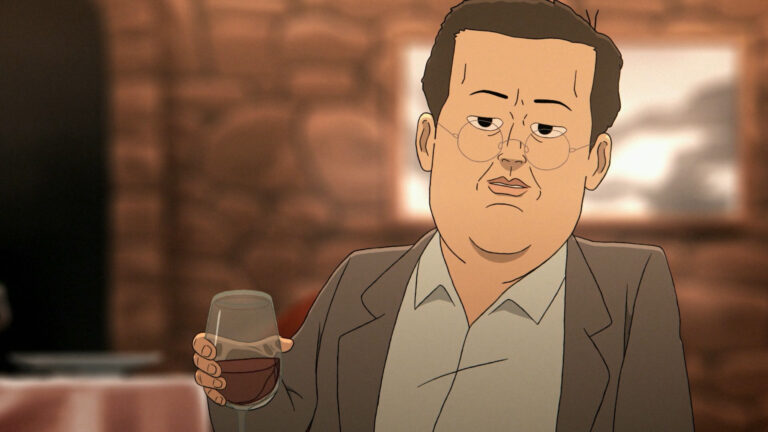
At the center of Common Side Effects is a conspiracy that depends on institutions behaving like institutions. The show follows Marshall and Frances, described as former high school lab partners. Marshall discovers the “Blue Angel” mushroom, which has major healing effects. Their discovery pulls them into a story involving Reutical Pharmaceuticals, Inc. and the government, with a push to suppress what the mushroom can do.
That “big pharma plus government” shape is not just a fan interpretation. Adult Swim’s official series description in Warner Bros. Discovery press materials explicitly frames the series as a conspiracy involving big pharma and the federal government. The cast list and character roles reinforce it. Frances Applewhite is described as working for Reutical Pharmaceuticals, tying a central character directly to the corporate side of the story. The series also includes DEA agents, Copano and Harrington, which adds an enforcement layer to the narrative.
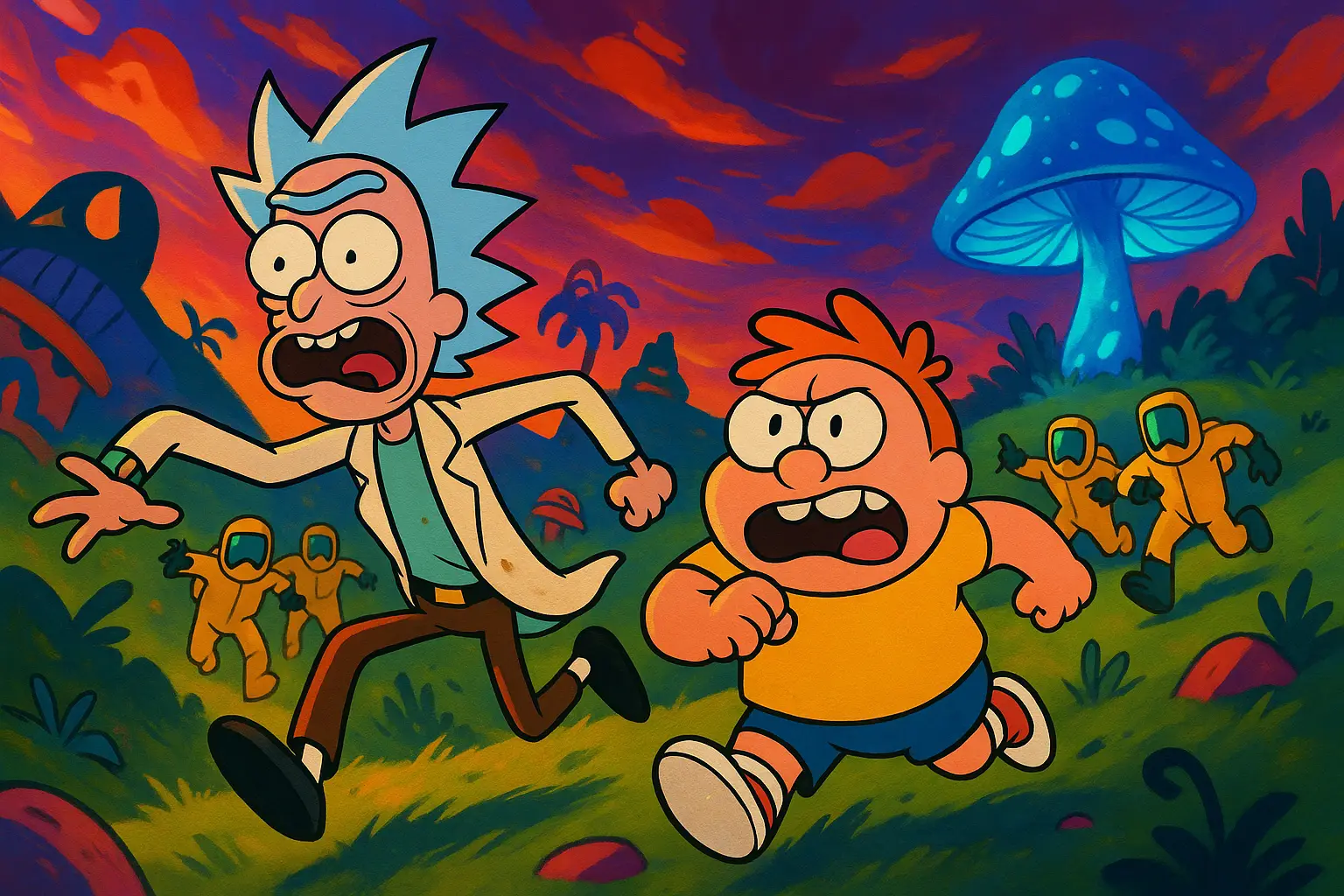
Meanwhile, Rick and Morty has often treated “medicine” more like a sci-fi device that breaks reality, rather than a system that hides secrets. The clearest, cleanest episode example is “Rick Potion No. 9”. Wikipedia lists it as Season 1, Episode 6, and says it aired January 27, 2014 on Adult Swim. In that story, Rick creates a love serum for Morty. The plot then turns when the serum merges with the flu, becoming an airborne outbreak that affects the population.
The distinction matters. Common Side Effects builds its thriller mechanics around suppression, incentives, and institutional response. Rick and Morty uses a potion that becomes a public-health disaster, then rides the consequences for narrative acceleration.
Both are “pharmaceutical-focused,” but they aim at different targets. One points at systems. The other pulls the pin on a chemical mistake.
Common Side Effects leans into thriller tone, and the creators describe it that way
The creators of Common Side Effects have been explicit that they aimed for more than one-note comedy. Reporting around the show describes it as a half-hour comedy/thriller. That genre blend comes through in interviews, too. In an interview with TheWrap, co-creator Steve Hely described the tonal goal as moving between funny, intense, and dramatic, and said they were aiming for something “totally new.”
Polygon’s reporting makes the show’s thriller DNA even more concrete. The creators told Polygon they drew from conspiracy thrillers and cited influences including the Coen brothers, The X-Files, and films like Erin Brockovich and The Insider. Those aren’t casual references. They signal a set of expectations: investigative momentum, hidden incentives, and protagonists pushing against powerful institutions.
Polygon also reported that the team emphasized research, speaking with people connected to pharma, mycology, law, and biology. That detail is especially useful for a comparison article, because it helps explain why Common Side Effects works hard to feel grounded in procedures and professional domains. The show is still animated and comedic, but it wants the conspiracy to feel like it could be assembled from real-world parts.
The Verge pushed that framing even further in an interview, saying the show’s antagonist is less one bad person than the U.S. healthcare system, described as corrupt and profit-driven. That is a very specific target for an Adult Swim series, and it helps explain why the show often reads like a thriller with jokes, rather than a comedy that occasionally references conspiracies.
Rick and Morty stays elastic: huge scale, fast pivots, and franchise reach
Rick and Morty is not shy about big ideas either, but its official positioning is different. Warner Bros. Discovery’s Season 8 press release called it Adult Swim’s #1 series. The company also said the show was the #1 comedy across all of cable during seasons 3 — 6. That same press release credited the series with two Emmys for “Outstanding Animated Program.”
Those details are useful because they signal what the network expects from the show: scale, broad attention, and long-term cultural footprint. WBD’s global distribution claims also underline that point. The company said Rick and Morty debuts in over 170 countries and 42 languages.
In other words, Rick and Morty has to work at franchise speed. A “potion” episode can be both a riff on teen romance and a pseudo-epidemic plot. It can do that because the series has spent years training viewers to expect sharp turns.
When you compare it with Common Side Effects, the result feels like two different conspiracy clocks. Common Side Effects wants you to sit with the mechanics of suppression. Rick and Morty often wants you to watch a bad idea scale instantly.
Animation production: Common Side Effects foregrounds a distinct, credited pipeline
One advantage in comparing animation styles is that Common Side Effects has several specific, citable production details in public sources.
Wikipedia’s production notes credit animation to Green Street Pictures. They also describe an international, remote-friendly pipeline with artists working from countries including France, Portugal, Spain, and Mexico. The same notes mention collaboration with Le Cube in Argentina.
Those credits matter because they give you something concrete to point to when discussing the show’s look. You can connect style to process, not just taste. Wikipedia’s description also notes “distinct visual style” elements, including exaggerated proportions, such as oversized and undersized character features.
The show’s production context also overlaps with the larger Adult Swim animation ecosystem. Wikipedia’s production section links personnel to Scavengers Reign through Joe Bennett and Green Street, which helps place Common Side Effects within a contemporary wave of adult animation that cares about atmosphere and design clarity, even while telling jokes.
For Rick and Morty, the verified facts in the current research set skew more toward distribution and franchise scale than animation pipeline. Still, the contrast is informative. Common Side Effects enters the conversation with visible studio credits and a described international workflow. Rick and Morty enters with reach metrics, awards, and global release framing from corporate press materials.
Pharmaceutical themes: suppression and incentives versus unintended consequences
Both shows can plausibly be described as pharmaceutical-focused, but they use that focus in different ways.
In Common Side Effects, the medical discovery is the central premise: Marshall discovers a mushroom with major healing effects. The show’s conspiracy involves Reutical Pharmaceuticals, Inc. and the government, with the implied question of who benefits when a cure is controlled or buried. That’s also why Frances’s job matters. When a main character works inside a pharma company, scenes can play out across internal pressure, compliance concerns, and moral conflict, instead of only external chase sequences.
In Rick and Morty, the most direct, well-documented “pharma” parallel in this research set comes from “Rick Potion No. 9.” The episode turns a love serum into an airborne disaster when it interacts with the flu. That is a very specific kind of medical storytelling: chemistry as unintended consequence, moving too fast for anyone to control.
Even the numbers around that episode help. Wikipedia reports the first airing drew 1.7 million viewers. That doesn’t prove long-term cultural impact on its own, but it does show the episode had a measurable audience on a defined night. It also gives you an anchor if you want to discuss how early Rick and Morty episodes established the show’s “science as catastrophe” rhythm.
Who’s making these shows, and why that matters for tone
Common Side Effects has a creator lineup that signals a certain kind of comedy discipline. The show was created by Joe Bennett and Steve Hely. Warner Bros. Discovery’s press release also lists Mike Judge and Greg Daniels as executive producers through Bandera Entertainment. Adult Swim announced the order in a press release tied to the Annecy International Animation Film Festival.
Those are names associated with character-based comedy and workplace satire. That context helps explain why a conspiracy thriller about healthcare can still land jokes and human awkwardness. It also suggests why the show’s “system” villain framing, as described in The Verge, can coexist with a comedic voice.
Rick and Morty’s current production leadership and casting also comes with clear documentation. WBD’s Season 8 press release identifies Dan Harmon as executive producer and Scott Marder as executive producer and showrunner. It also lists Ian Cardoni as the voice of Rick and Harry Belden as the voice of Morty for Season 8.
There’s also the well-documented public turning point in 2023. TIME reported that Adult Swim cut ties with co-creator and voice actor Justin Roiland in January 2023. TIME also reported that charges against Roiland were dropped March 22, 2023, and that the series continued with recasting. Those dates matter in any 2026 discussion of the fan community and the show’s longevity, because they mark a shift that the franchise survived and moved past, at least operationally.
Fan communities: one show is a global machine, the other is building momentum
Hard metrics for fan communities can be tricky without pulling platform-specific numbers. In the current verified set, the clearest quotable fan-related statement is tied to Common Side Effects.
When Adult Swim renewed Common Side Effects for Season 2, Adult Swim president Michael Ouweleen credited fans watching “on Adult Swim and Max,” and referenced audiences “lighting up your socials.” The renewal was announced March 28, 2025, and The Verge reported Adult Swim did not provide a Season 2 release date at that time.
That quote matters because it shows how Adult Swim talks about success for a newer series. The network pointed to cross-platform viewing and social activity. It did not cite Nielsen figures or viewership totals in the materials captured here, but it did frame the renewal around engagement signals.
For Rick and Morty, the fan-community story is partly told through reach. WBD’s press release described the show as a “global phenomenon,” with releases in over 170 countries and 42 languages. It’s not a subreddit count, but it is a concrete, company-stated scale that helps explain why the fandom functions like a worldwide franchise community rather than a niche audience cluster.
What Happens Next: 2026 context for both shows
As of January 2026, Common Side Effects sits in a clear “season-one established, season-two ordered” position. Adult Swim renewed it for Season 2 on March 28, 2025, and reporting at the time said there was no release date announced.
Rick and Morty sits in a different place. Season 8 has defined dates and an official streaming timeline. It premiered May 25, 2025, ran through July 27, 2025, and began streaming in the U.S. on September 1, 2025.
That’s the cleanest way to frame the comparison right now. Rick and Morty remains Adult Swim’s flagship, backed by corporate claims like “#1 series,” multi-season cable rankings, and global-language distribution. Common Side Effects is newer, but it has already secured a second season and has creators on record describing a deliberate blend of comedy, drama, and conspiracy-thriller tension.
If you want the next iteration of this article to go deeper, the research gap is obvious: hard, citable fan-community metrics and more “pharma plot” examples across Rick and Morty beyond “Rick Potion No. 9.” Those can be gathered with another targeted search pass. For now, the documented record already supports a strong January 2026 comparison: two Adult Swim shows, two approaches to medicine-driven storytelling, and two very different ways to make paranoia funny.